True North Leadership Lab
The True North Leadership Lab is a place for people exercising leadership in complex systems to slow down, think together, and practice differently.
The lab is designed primarily for people exercising leadership in health systems, education, and complex public institutions, and for executives seeking serious leadership education grounded in practice.
The work we take up here is difficult and meaningful. It involves disagreement that cannot be resolved by expertise alone, losses that must be named rather than avoided, and choices that carry consequences no one can fully control. These are not technical problems. They are adaptive ones.
The lab is grounded in the body of work known as Adaptive Leadership, developed by Ronald Heifetz and colleagues, and deeply shaped by what we can learn from art, music, and performance. Ben Zander’s teaching reminds us that how we listen, how we show up, and how we relate to one another often matters more than what we say or decide. Leadership is not only analytical. It is human, relational, and lived in the moment.
True North Leadership Lab is not a single course or program. It is a container for learning, practice, and gathering. Sometimes that takes the form of one-day explorations. Sometimes it becomes multi-day intensives. Sometimes it looks like a consultation, a case, or a conversation that changes how someone understands their role in a system.
Across all of it, the commitment is the same:
to create learning environments where people can stay present with complexity, resist the pull toward premature action, and take responsibility for the work that only they can do.
What follows describes how that commitment takes shape in practice.
How we teach and learn
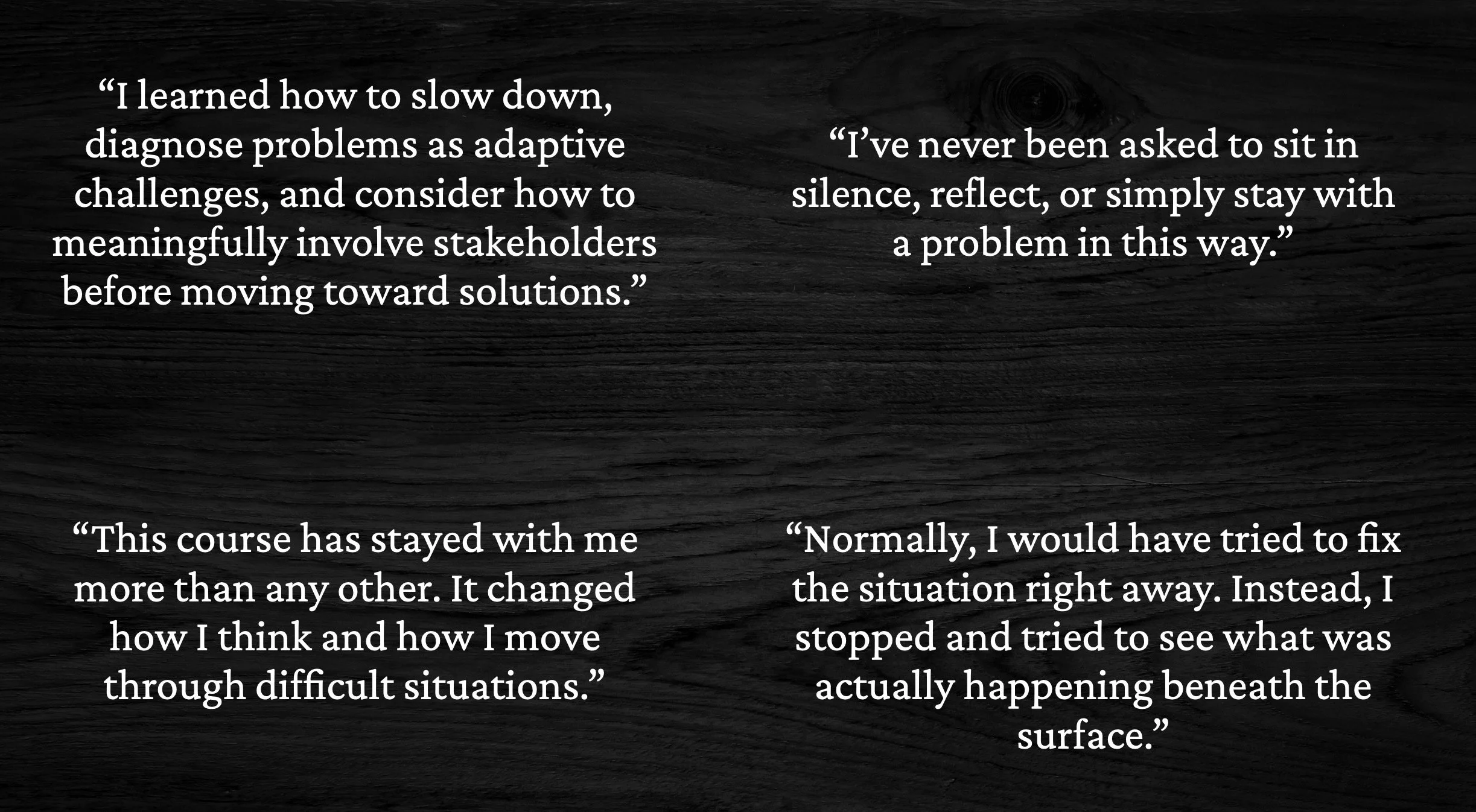
The lab’s methods are drawn directly from the practice of adaptive leadership and from years of teaching in settings where the stakes are real and the work is unfinished. Learning happens through case-in-point teaching, collective diagnosis, and structured experimentation rather than lectures or best-practice transfer.
In multi-day intensives especially, participants work with real leadership challenges they are currently facing. The group becomes the learning instrument. Attention moves deliberately between the case, the system it sits within, and what is happening in the room as the work unfolds. Authority, resistance, loyalty, identity, and loss are treated as sources of information rather than obstacles to overcome.
This work requires full presence. Participants are asked to stay engaged even when the material becomes uncomfortable, ambiguous, or personally exposing. The goal is not mastery of a framework, but increased capacity to notice, interpret, and choose more deliberately when the heat is on.
The longer intensives reflect this approach most fully. They are designed as immersive learning environments where people practice exercising leadership in real time, with others who are doing the same.
This work is informed by practices of non-defensive defense, especially in moments of conflict, secondary disclosure, and institutional strain, where staying present matters more than winning or persuading.
Learning with others
The True North Leadership Lab is not a solo effort.
Courses and gatherings often include additional faculty and facilitators who bring complementary experience in adaptive leadership, education, health systems, ethics, and organizational work. We are deeply grateful to work alongside others who share a commitment to this practice and who help hold the learning environment with care and rigor.
This shared faculty model matters. Adaptive work is relational by nature, and the lab reflects that truth in how it is staffed and facilitated.
What participants are asked to bring
Every offering in the lab asks participants to arrive with a real leadership challenge or failure.
This is not preparation in the conventional sense. Participants are invited to identify a situation where they feel stuck, conflicted, uncertain, or implicated. Something unfinished. Something that still carries heat.
A short written assignment is used across all courses to help participants surface the adaptive dimensions of their case before arriving. This assignment forms the backbone of the learning, allowing the group to work with challenges that matter rather than hypotheticals.
This same structure is used whether the offering is one day or multiple days. The work begins before people enter the room.
Leadership consultations
The lab also offers leadership consultations conducted virtually using the adaptive consultation process.
These sessions focus on collective diagnosis rather than advice-giving. The aim is to help the case protagonist see their situation more clearly by examining patterns, factions, losses, and loyalties that may not yet be visible. Consultations are structured, disciplined, and deliberately slow the rush to solution.
Consultations can be used by individuals, leadership teams, or groups navigating complex challenges and are often paired with ongoing learning in the lab.
Ways to engage
The lab offers one-day explorations, multi-day intensives, and consultation-based work.
Some people encounter the lab through a course; others through consultation or ongoing learning.
Those who have participated are invited to stay connected through shared language, continued practice, and periodic gatherings.