Lines of Code, Identities, and the Waters We Carry
Much of the work that matters most in complex systems is not technical. It cannot be solved by better rules, clearer processes, or more expertise alone. It involves values in tension, losses that have not been fully named, and identities that are quietly being shaped by what we are asked to carry.
My work is grounded in the practice of exercising leadership in these conditions. It draws heavily from Adaptive Leadership, particularly the work of Ron Heifetz, and from years of teaching, clinical practice, and system work in health care. It is concerned less with answers and more with how people stay present, steady, and responsible when the work is difficult and the way forward is unclear.
This page describes how I think about that work. It begins outside in, where most of us are trained to operate, and then turns inward to examine what changes when we slow the sequence down and place responsibility not only on action, but on the person choosing it.
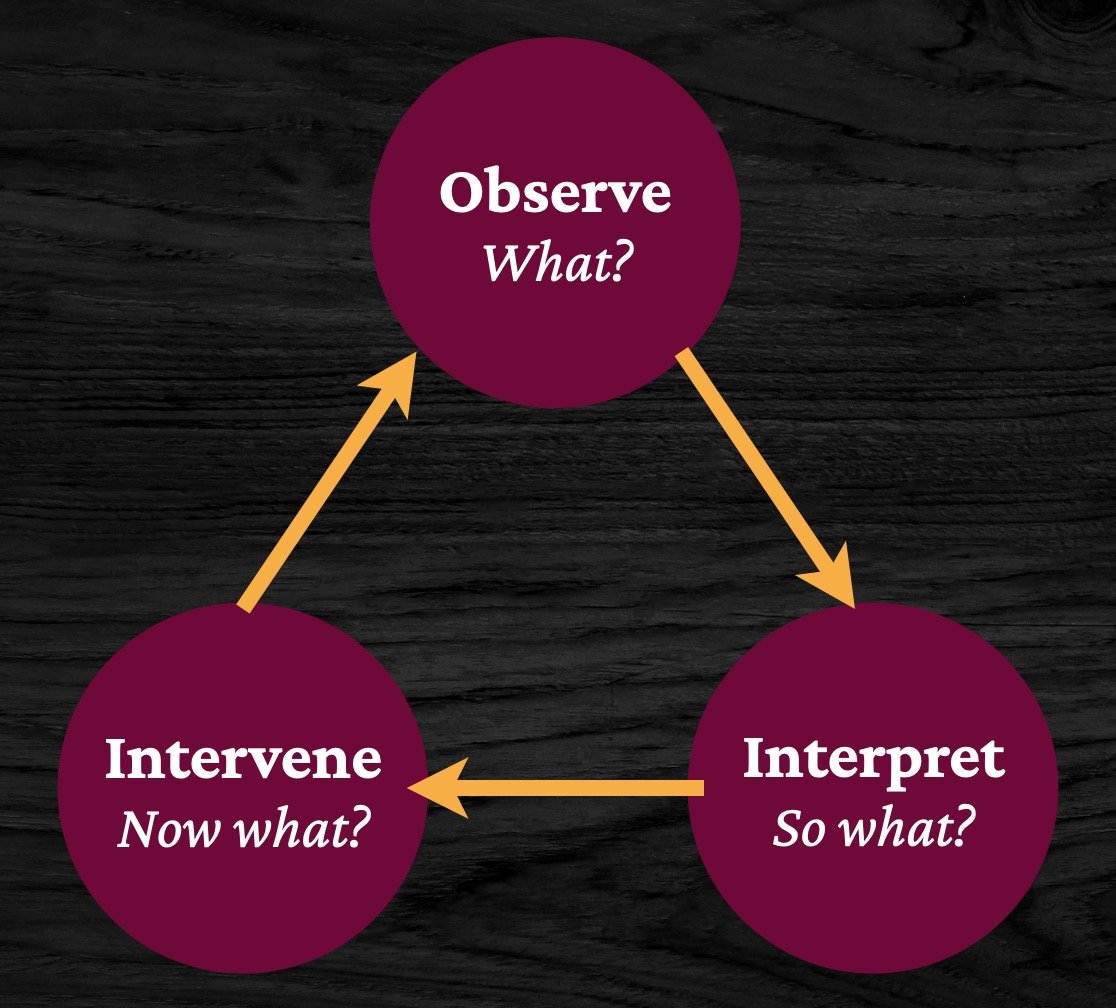
A common way of working
In pressured environments, the work often follows a familiar sequence. We observe what is happening, interpret what it means, and move quickly to intervention. This way of working is efficient, competent, and often necessary. It allows systems to function and decisions to be made under constraint.
Over time, however, this sequence can narrow what we notice and compress how we decide. Action becomes reflexive. Interpretation hardens into certainty. The cost of speed is often paid quietly, in the form of unexamined loss, defended identities, and work that feels increasingly brittle.
The sequence itself is not the problem. What matters is where the work is being done.
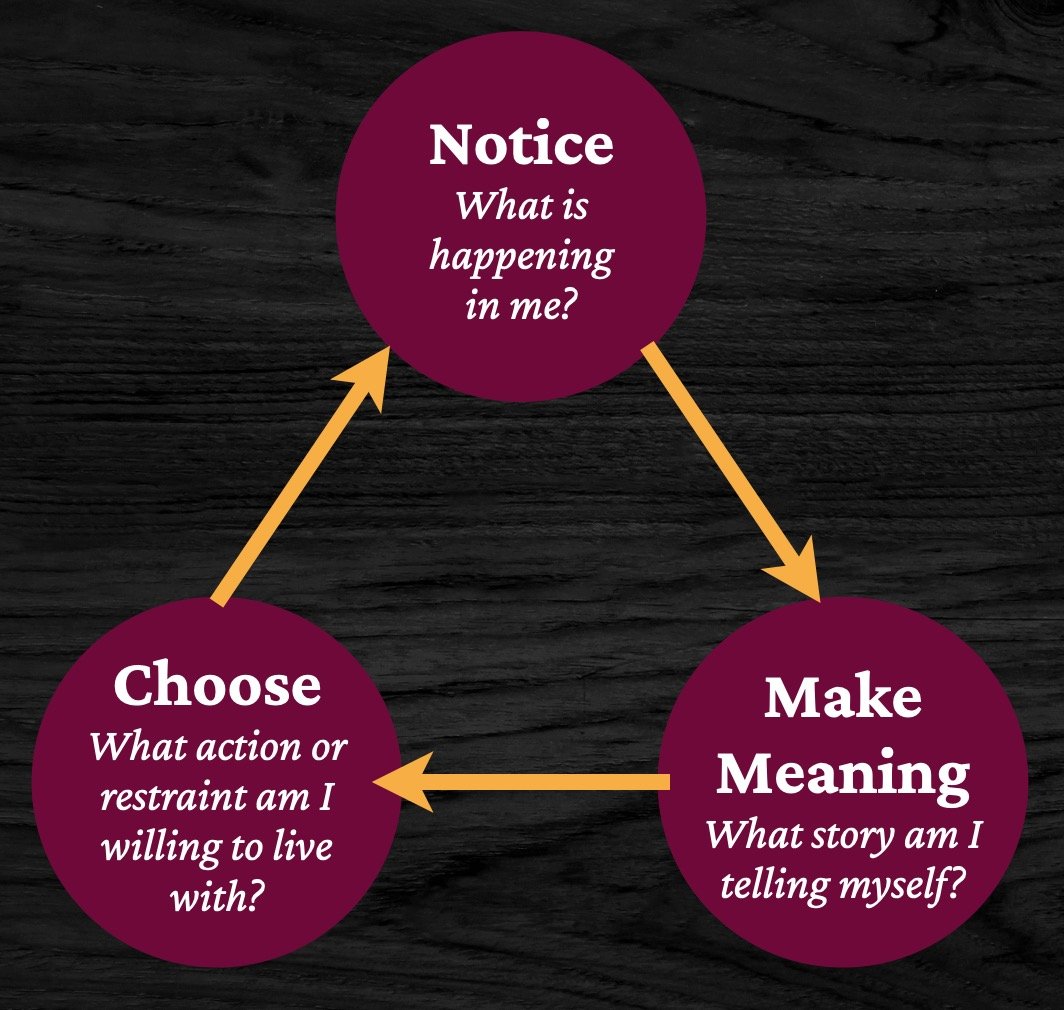
The same sequence, turned inward
The inside-out version of the work uses the same structure but shifts the location of responsibility. Before acting, attention is placed on what is happening internally. What signals are present. What emotions, loyalties, or urgencies have been activated.
Meaning is then examined, not assumed. What story am I telling myself about what is at stake. What identity feels threatened or affirmed. What loss am I protecting against.
Only then does choice come into view. Not just what action to take, but what action or restraint I am willing to live with. Including the possibility of disappointing people at a rate they can tolerate.
This shift does not remove action. It changes its quality. The sequence itself is not the problem. What matters is where the work is being done.

In Ron Heifetz’s analogy, the holding environment is the pot. It is not the heat itself, but the structure that contains heat so the work can cook without spilling or burning. Without heat, nothing changes. With too much, people withdraw, defend, or disengage. The holding environment makes learning possible by allowing difficulty to stay in the room long enough to be understood.
Lines of code
Over time, repeated responses to pressure become patterns. These patterns write lines of code that quietly shape how a person exercising leadership notices, interprets, and chooses. They are rarely explicit. Most are learned early, reinforced often, and rewarded just enough to feel right.
Some lines of code sound like competence. Move quickly. Do not hesitate. Take responsibility. Others sound like virtue. Be helpful. Absorb the strain. Do not make things harder for others. Still others emerge from environments where certainty was prized and doubt was dangerous. In those settings, decisiveness becomes safety.
I recognize many of these lines in my own practice. They have helped me function in high-stakes clinical and system settings. They have also narrowed what I could tolerate. Over time, I noticed that speed sometimes replaced judgment, endurance replaced honesty, and restraint felt uncomfortably close to failure. None of this was intentional. The lines were simply running.
Inside-out work created a pause long enough to see those patterns at work. Not as flaws to correct, but as adaptations to environments that demanded a great deal. Some lines protected me. Others quietly limited the range of choices I could imagine, especially when conflict, disappointment, or loss were present.
One of the most difficult recognitions was how often my impulse to act was tied to my own discomfort rather than the needs of the work. Intervening relieved pressure. Explaining restored a sense of control. Fixing reduced anxiety. These moves felt responsible. They were also ways of escaping uncertainty.
Learning began when I could stay with that discomfort a little longer. When I could notice the urge to move, name the story I was telling myself about what would happen if I did not, and then choose more deliberately. Sometimes the choice was still to act. Other times it was to wait, to ask a different question, or to let others carry what did not belong to me.
This is the work of rewriting lines of code. Not through force or self-critique, but through attention. Through recognizing that identity is being shaped in small moments, often when no one is watching. What we practice under pressure is what we become.
Lines of code describe the patterns we run under pressure. They are shaped by experience and reinforced by reward. They are not the whole story of where they come from.
Holding steady
Much of this work involves staying present in moments that invite escape. The urge to fix, defend, explain, or withdraw is often a signal that something important is being touched. Holding steady means resisting the impulse to make discomfort disappear before it has taught us anything.
This is not passive work. It requires attention, restraint, and care for both the person and the system. It is slow, relational, and often uncomfortable. It is also where durable learning begins.
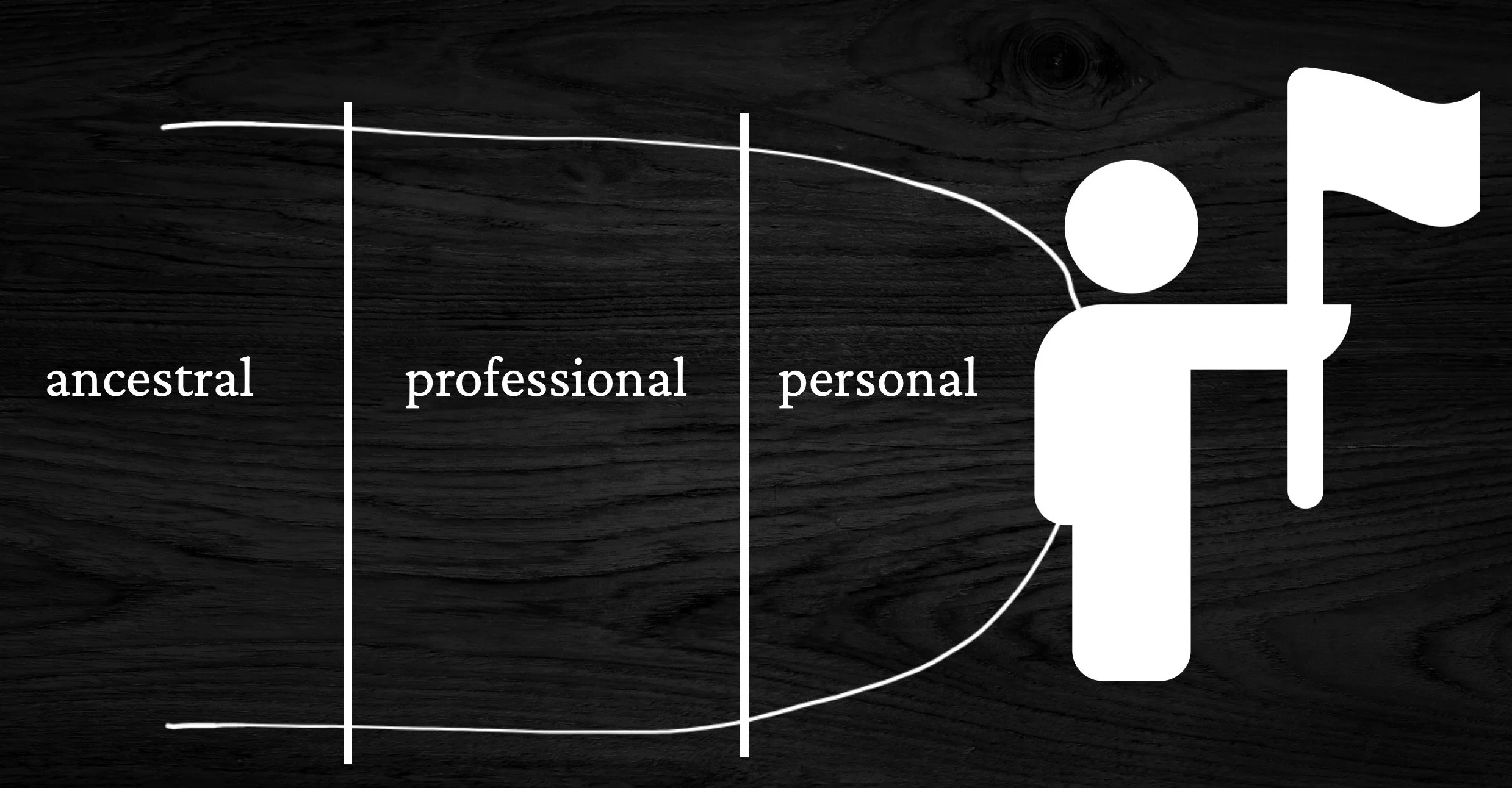
Waters we carry
Even when a person exercising leadership is able to pause, notice, and hold steady, the work is never neutral. Each of us enters difficult situations carrying histories, loyalties, expectations, and unfinished business that shape what feels tolerable and what does not. These are the waters we carry.
Some of this water is personal. Family stories about responsibility, conflict, safety, and worth leave traces that surface under pressure. Early experiences of approval, withdrawal, or abandonment quietly inform how risk is felt and how disagreement is interpreted. What looks like overreaction in the present is often a reasonable response to an older landscape.
Some of the water is professional. Training environments reward certain behaviors and discourage others. In many high performance systems, steadiness is equated with certainty, speed with competence, and emotional restraint with maturity. Over time, these norms shape not just how people act, but how they evaluate themselves. Doubt becomes weakness. Slowness becomes failure. Asking for help becomes exposure.
Some of the water is ancestral and cultural. Inherited stories about sacrifice, endurance, loyalty, authority, or survival can exert powerful influence, even when they are never spoken aloud. These waters shape what feels honorable, what feels dangerous, and what losses are considered acceptable. They often show up most clearly when change threatens identity rather than outcome.
Waters we carry are not problems to solve. They are sources of information. They explain why two people can face the same situation and experience very different levels of threat, urgency, or despair. They help make sense of why some losses feel manageable and others feel unbearable.
Adaptive work requires learning to notice this water without being governed by it. Not to empty it, deny it, or purify it, but to recognize when it is influencing interpretation and choice. When despair rises quickly, when defensiveness feels necessary, when withdrawal looks like relief, it is often the water speaking.
Inside out work creates the possibility of choice in these moments. By naming what is being stirred, a person exercising leadership can decide whether the response belongs to the present challenge or to an older one. This does not eliminate pain or loss. It clarifies responsibility.
Over time, this attention changes what can be carried. Some burdens loosen. Some loyalties are renegotiated. Some expectations soften. The water does not disappear, but it becomes less likely to spill unnoticed into action.
This is not self-improvement work. It is responsibility work. It allows a person exercising leadership to stay in the room longer, listen more carefully, and act in ways that are more aligned with the work itself rather than the need to escape discomfort.
What we carry matters. Not because it defines us, but because it shapes the space between impulse and choice.
What we carry into the work is shaped long before the moment of action.
Next steps
If this way of working resonates, there are several places to continue exploring it.
In teaching, through case-based learning that brings adaptive leadership into dialogue with complex health system practice.
In reflective work, through deeper examination of lines of code, identity, and the conditions that shape how responsibility is taken up.
And in shared spaces, where people come together to sit with difficult questions long enough for learning to occur.
Those paths are outlined elsewhere on this site.