My Leadership Values
This page holds the values and commitments I try to return to when the work gets hard. They are not a performance standard. They are a set of orienting principles that shape how I show up in health care, education, and system work, especially in moments of uncertainty, conflict, and loss.
My thinking here has been shaped by many influences. Ben Zander’s teaching and mentorship has been foundational. My journey through crisis leadership and meta-leadership has also contributed important tools and perspectives, especially through the National Preparedness Leadership Initiative. Over time, I have become more fully grounded in the adaptive leadership framework. These values are where those threads meet.
“System awareness and systems design are important… but are not enough. Ultimately, the secret of quality is love.”
— Avedis Donabedian
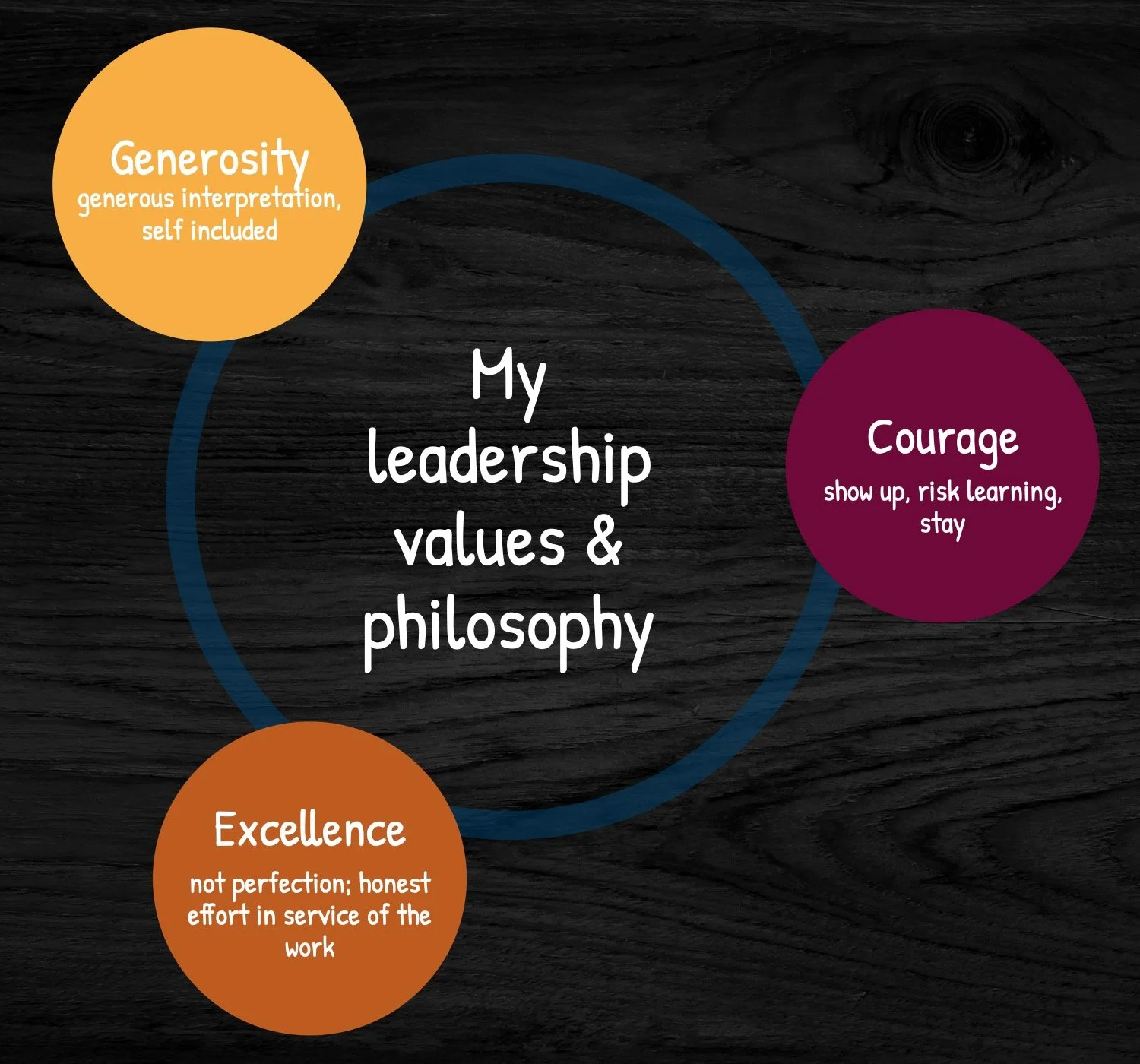
Generosity
Generosity is the most important thing in this set. It is the discipline of assuming good intent, making room for complexity, and resisting the urge to flatten people into caricatures when the pressure is high.
Generosity also means being generous with myself. When I am frustrated, impatient, or tempted to judge, it is often a signal that I am carrying more than I realize, or protecting something that matters to me. Generosity creates space for curiosity and for better diagnosis.
Never doubt the capacity of the people you are leading to realize what you are dreaming. - Benjamin Zander
The leader is the relentless architect of the possibility that others can be. - Rosamund Stone Zander
Courage
Courage is the willingness to stay in the work when there is no easy answer. In health systems, courage rarely looks dramatic. It looks like holding steady, telling the truth clearly, and remaining present when others are uncomfortable, disappointed, or uncertain.
Courage is also relational. It is built through trust, intentionally and by action. It requires clarity of values and a willingness to be seen.
Built trust. Intentionally and by action. Be vulnerable. Show up and be seen. Clarity of values.
Excellence
Excellence is not perfection. It is commitment to the right goal for the right reason, and to fairness of process in a patient-centred fashion.
Excellence requires honesty. It requires disciplined attention to what is actually happening. It asks for clear language rather than performative confidence.
Excellence is not perfection. Clear is kind. Honest conversations.
As Donabedian has said:
System awareness and systems design are important for health professionals but are not enough. They are enabling mechanisms only. It is the ethical dimension of individuals that is essential to a system’s success. Ultimately, the secret of quality is love.
Possibility and contribution
Ben Zander’s teaching continues to influence how I understand possibility. Possibility is not optimism. It is a stance that changes what people notice, what they believe is available to them, and what becomes thinkable in the room. It is about believing that the job of a person exercising leadership is to create shining eyes in the work; it is not about wealth, fame and power.
Contribution is the antidote to performance. When contribution becomes the goal, leadership becomes less about impressing others and more about meeting the moment.
This is the moment. This is the most important moment right now. Which is, we are about contribution. That’s what our job is. Not about impressing people. It’s not about getting the next job. It’s about contributing something. - Ben Zander
A good change leader never thinks, “Why are these people acting so badly? They must be bad people.” A good change leader thinks, “How can I set up a situation that brings out the good in these people?” - Chip Heath
Where these values meet the inside-out work
Values matter most when they are tested.
In the inside-out work, I have learned that values are not simply what I believe. They are what I protect, what I avoid, and what I default to when the heat rises. The Lines of Code work makes that visible.
Generosity is tested when I feel impatient or certain.
Courage is tested when disappointing people feels dangerous.
Excellence is tested when speed threatens clarity or fairness.
Possibility is tested when the system feels stuck.
This is one reason I care so much about the inside-out practice. It creates a pause long enough to notice what is happening in me before I act. It makes it possible to choose instead of react.
If you want to go deeper into that work, the Lines of Code, Identity, and the Waters We Carry page explores the internal patterns, loyalties, and pressures that shape how values are lived.
Meta-leadership, crisis, and adaptive work
Earlier in my leadership development, I was deeply shaped by crisis leadership tools and meta-leadership frameworks, including concepts such as cone in the cube and swarm leadership. Those ideas still matter to me. They remain useful ways to think about coordination, shared direction, and distributed response under pressure.
Over time, adaptive leadership became the deeper foundation. It helped me see that many crises contain both technical and adaptive work, and that the hardest part is rarely the absence of a plan. It is the need to hold tension, name losses, and mobilize learning when people would rather avoid it.
I continue to carry the best of those traditions forward, but these values are the clearest statement of where I stand now.
A personal grounding
I am most vulnerable when I think and talk about parenting.
My family fills my heart with love. When you come to work armed with this, you can meet everything with a new outlook. Even post-pandemic when everyone, patient, colleague, friends, children, are suffering burnout, love will drive us forward.
These values are not a claim of virtue. They are a commitment to practice.
They remind me that leadership is not only analytical. It is human. It is relational. And it is lived in the moment.